
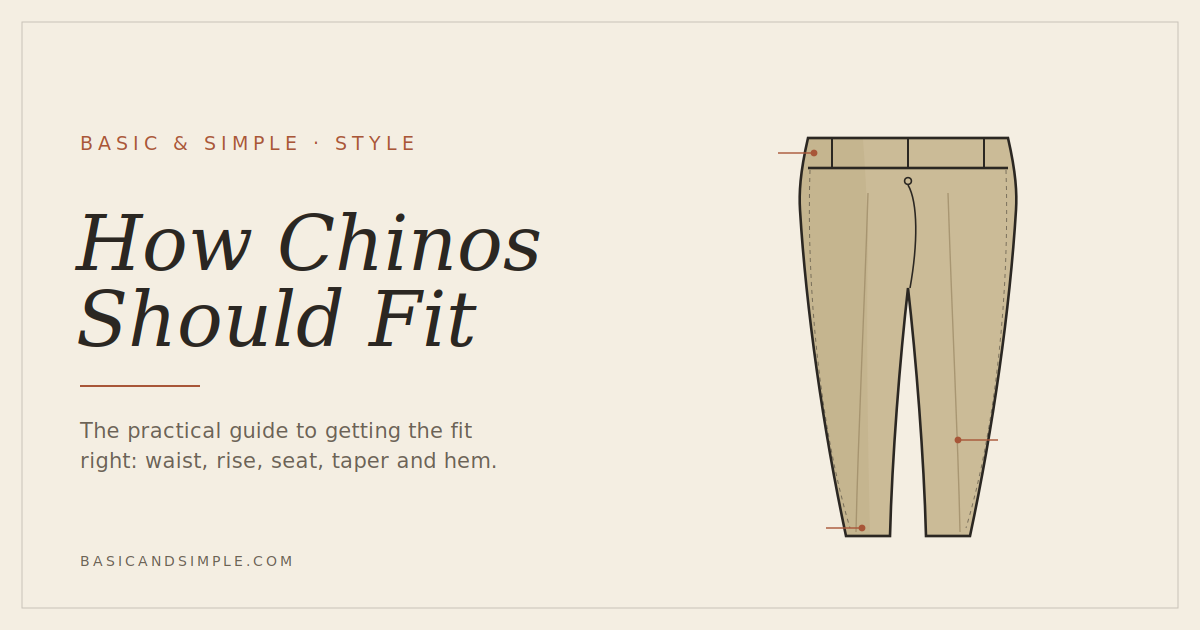
I’ll start with the distinction most chino guides skip, including the first version of this one.
Two different questions hide inside “how should chinos fit.” The first is whether they fit at all: whether the waist holds, whether the seat sits clean, whether you can sit down without the fabric fighting you. That part is close to objective. A trouser either works with your body or it doesn’t. The second is which cut you like: high or low rise, slim or wide leg, cropped or breaking on the shoe. That part is taste. There’s no correct answer, only trade-offs and the look you’re after.
Most advice blurs the two and passes off one person’s preferred cut as a universal law. I’ve done it myself. So this time I’m splitting them. First the fit checks that have a real right and wrong. Then the choices that are yours, where I’ll tell you what I wear and why, without pretending it’s the only answer.

Part one: the fit that isn’t up to you
Be strict about these. They decide whether a trouser looks considered or careless, and they’re the ones that cost money to fix once you’ve bought wrong.
The waist
The waist should stay up on its own, no belt doing the work. That’s the whole test. If a belt is the only thing stopping them sliding down, the waist is too big. If you’re undoing the button after lunch, too small. You should be able to slip two fingers inside the waistband, and not much more.
A belt is a finishing touch. If it’s holding the trousers up, something’s off.
The seat and hips
This is where a lot of chinos quietly go wrong, and it’s one of the harder things to fix later.
The seat should sit clean, with no empty fabric sagging under your backside and no strain pulling across it. Loose folds hanging below the seat mean too big. Fabric pulling tight, back pockets stretched flat, means too small. The side pockets give it away: if they gape and splay open when you stand normally, you’re too tight through the hips.
A tailor can take in a seat that runs a little generous. One that’s too small can’t be let out, because the fabric simply isn’t there. So check it properly before you pay.
The thighs
Only one thing here is truly objective: the trouser shouldn’t grip or strain across the thigh, and you should be able to move in it. Stairs, a long meal, a car, none of it should make the fabric pull. How much room it carries beyond that is the cut, which I come to in part two.
Two changing-room checks tell you most of it.
The pinch. Standing normally, grab the fabric at the side of your thigh. Nothing to take hold of means too tight, and that holds on any cut. Past that, the amount is down to the cut: a slim leg leaves you a centimetre or two, a relaxed leg leaves more by design. Stiff cotton reads tighter than soft suit cloth, so treat it as a feel more than a measurement.
The sit. Sit all the way down and cross one leg over the other. Anything pulls or digs, the thighs are too tight. I trust this one most. Chinos spend half their life on a chair, and a pair that’s uncomfortable to sit in at the shop will nag at you every day you own it.
Reading a bad fit in the mirror
Most guides describe good fit. Fewer teach you to spot a bad one, which is the more useful skill, because wrong is easier to see than right. One rule carries most of the load: tight makes lines, loose makes folds.
- Horizontal creases pulling across the thigh or seat: the cloth is stretched over something it can’t cover. Too tight.
- Fabric puddling below the shoe: the hem is too long, and any tailor fixes that cheaply.
- Back or side pockets gaping open: too tight through the seat and hips.
- Fabric sagging like a hammock under the seat: the seat is cut too big, or the trousers are sitting lower than they should.
- Creases fanning out from the crotch: a rise or thigh that isn’t working.
Get the pull-line-versus-fold distinction into your eye and the rest mostly follows.
Part two: the choices that are yours
Here’s where I split from guides that hand you one right answer. Rise, leg width and length aren’t fit problems with correct solutions. They’re style choices, and the best one depends on the look you want, your proportions, and yes, the year, because all three move with fashion. Trade-offs first, then what I personally do. Take the reasoning and leave the preference if yours runs the other way.
Rise: how high they sit
Rise is the distance from the crotch seam to the top of the waistband. In plain terms, how high the trousers sit on you. Most people never choose it consciously, and it shapes the character of a chino more than almost anything else.
Every option is legitimate. A low rise sits on the hips, casual and modern, close to how jeans sit. A mid rise sits an inch or two higher, around the top of the hip bone. A high rise sits at or near the natural waist, more classic and tailored, sometimes vintage, and it’s the natural home for pleats. A high-rise pleated chino is a deliberate, well-dressed choice. It’s having a real moment right now.
I wear a mid rise most of the time. It’s the most versatile of the three, it lets the seat and legs hang cleanly, and it sits right under both a tucked and an untucked shirt. Drawn to a fuller, more classic look? Go higher. Live in cropped, casual outfits? Lower can be right. Either way you’re choosing a look.
The one part that isn’t negotiable: rise is the hardest thing on the trouser to alter. Changing it means rebuilding the garment, and it’s rarely worth the money. So settle on your rise before you buy. You’re committed the moment you do.
Leg width and taper
A generation of style advice insisted every trouser taper to a narrow ankle. That was fashion talking, and it’s shifting. Straight and wider legs are back, and on the right person they look good.
Your options: a tapered leg narrows from thigh to ankle, trim and contemporary. A straight leg holds one width down, classic and easy. A relaxed or wide leg keeps its volume all the way, modern in a fashion-forward way, and kinder to bigger builds. All three work. Which suits you comes down to your proportions and how loud a fashion signal you want to send.
My own legs run a gentle taper or straight, depending on the shoe. I’ve moved off a heavy taper, which dates a trouser fast, and I don’t reach for a very wide leg, which takes some confidence and the right outfit around it to carry off. But a wide leg is a look. Wear it if it’s yours. The only real fault in this whole category is a leg so narrow it grabs the calf and won’t drop back when you stand. That’s too tight, whatever you were going for.
Length and break
“Break” is the fold that forms where the hem meets the shoe. How much you want is almost pure preference, and it’s the cheapest thing to change: any tailor shortens a hem for next to nothing.
No break leaves the hem at the top of the shoe, ankle just about visible, clean and current. A slight break lets the fabric touch the shoe with a small fold, the safe classic middle. A full break stacks the fabric on the shoe, the traditional look, and it pairs naturally with wider, heavier, higher-rise trousers.
An earlier version of this article called a full break sloppy. That was me stating a preference as fact, and the reader who pushed back on it was right. On a full-cut classic trouser, a full break is correct and intentional.
I keep mine at no break, or close to it, because I mostly wear a slimmer-to-straight leg where a stack of fabric throws off the proportion. The rule, if there is one: match the break to the cut. Slim and cropped want little to none. Full and classic carry more. And a rolled cuff is fine in summer, one or two turns, no more.
Flat front or pleats
Most modern chinos are flat front, and it’s the easy default: trim, contemporary, happy with any leg. Pleats add room through the hip and thigh without sizing up, which helps if you’ve got muscular legs or just want more comfort and a more classic line. They read slightly vintage, which right now is a plus. First pair, go flat front. Once you know chinos are your thing, a single pleat is a smart second buy.
Fitting the choices to your build
None of this happens in a vacuum. Your proportions nudge the taste calls.
Athletic lower half? The usual headache is a waist that fits while the thighs and seat don’t. Size to the thighs and seat and have the waist taken in, which is quick and cheap. Pleats and a straighter leg both buy you room.
Shorter men get more from a clean hem with little break, which keeps the leg line unbroken, and from a mid rise over a low one. Very wide legs can cut your height, so go carefully there.
Tall, and length is the thing to watch. Too short shows badly on a long frame, so check the hem reaches the shoe before you commit. You can carry more break and more volume than most men.
Heavier builds are best served by a straight or relaxed leg that skims the body, and by a waistband sitting at the right height. That last point does more for the silhouette than the exact leg shape ever will.
Fabric and season
Weight decides how a chino hangs, and it’s measured in grams per square meter (gsm), when a brand bothers to print it on the label. A rough map: 170 to 240gsm is summer-light, airy but quicker to crease and less inclined to hold its shape. 250 to 300gsm is the all-year middle, where most chinos sit. Anything from 300gsm up is proper cold-weather cloth, with the structure to hang cleanly into winter. For one pair to cover most of the year, aim for that middle band.
One thing to look for at any weight: a little elastane, two or three percent. Pure cotton looks great and then stiffens and creases as the day wears on. A touch of stretch gives the cloth some recovery, so it settles back after you’ve been sitting. You barely feel it. You see it by evening. The exception is performance cloth like lululemon’s, which is largely synthetic: strong stretch, wrinkle-proof, but with a faint sheen and none of cotton’s breathability.
Where to actually buy
I keep the full shortlist, with current prices and fabric labels, in my guide to the best chinos in Europe under €200. The short version, matched to budget.
On the tightest budget, Uniqlo‘s slim chino at €39.90 is cut better than €40 has any right to be. Size up if you carry any thigh, because the slim really is slim. For the office, Suitsupply at €119 is the one I keep going back to, mostly because you can walk in, try it on, and have it altered the same afternoon, which matters more on trousers than any spec sheet. And if you want to spend more without feeling silly about it, Asket at €170 buys a fully published supply chain, while ISTO gets you a heavier 300gsm cloth for colder months at around €125.
Cross-reference the Basic and Simple brand directory too, especially if you’re after a particular cut, since brands lean consistently slim or consistently roomy.
The bottom line
Take the split, if nothing else. Whether a chino fits, at the waist, the seat, the thighs, is close to objective, and worth being fussy about, because it’s what reads as sharp or careless and what costs money to fix. Which cut you choose, the rise, the width, the break, is yours. Anyone selling you a single right answer there is selling you their taste.
My own default is a mid rise, a gentle taper or straight leg, and little to no break. That’s where I’ve landed, not where you have to. Get the fit right, pick the cut you actually like, and wear it with some conviction. That does more than any measurement.
